About this guide
This guide contains solutions for the first 100 problems from the Project Euler website. Full code, in a form of runnable classes, is available on GitHub: https://github.com/Detharon/ProjectEuler
The code is shared for educational purposes, demonstrating how these problems can be approached using Scala. There are many other sites that discuss Project Euler problems, but here, the purpose it twofold: discuss the problem while emphasizing Scala’s strengths of making efficient code that’s easy to understand.
So, whenever possible, a functional programming style is used, avoiding mutable state and vars. Some solutions intentionally deviate from this approach for performance comparison; these are marked with an ‘M’ suffix in their filenames.
While the non-functional style may yield greater efficiency by reducing object allocations, it often results in less readable and more error-prone code, so it is included primarily for contrast and learning purposes.
How to use this guide
My advice would be to read the solutions only when you’ve already solved the problem. It’s normal to struggle at the beginning. The first solution can be unoptimized and too slow to give the final result, but it’s a good starting point to think what can be improved.
Contributing
Even though it’s an individual work, that’s heavily influenced by my personal style, I’m open for contributions. If you want to add your some extra insights, you’ve found an error or a mistake, please send a pull request or raise an issue in GitHub.
Project status
The project it still in progress, with many problems missing. Some of them are solved but not described yet in this book.
Problem solutions
You can find the code for all the problems in the project repository, in src/main/scala directory.
All examples are runnable, and they only print the solution, along the execution time.
A commonly used code can be found in EulerHelper class, but other than that, the solutions are self-contained.
Multiples of 3 or 5
If we list all the natural numbers below 10 that are multiples of \(3\) or \(5\), we get \(3, 5, 6\) and \(9\). The sum of these multiples is \(23\). Find the sum of all the multiples of \(3\) or \(5\) below \(1000\).
Solution
The only tricky part of this exercise comes from the fact that we cannot simply count the multiplies of \(3\), then calculate the multiplies of \(5\), and add these two numbers up. If we did that, then the numbers that are divisible by both 3 and 5 would be calculated twice.
In this solution, we create three sets of numbers. If a number of divisible by both \(3\) and \(5\), then it’s divisible by \(15\), so we can find those numbers and subtract them from the two other sets.
object Euler001 extends EulerApp {
  override def execute(): Int = {
    val threes = (3 until 1000 by 3).sum
    val fives = (5 until 1000 by 5).sum
    val fifteens = (15 until 1000 by 15).sum

    threes + fives - fifteens
  }
}
The problem can be also solved by checking all the numbers to see if they’re divisible by \(3\) or \(5\). Shorter, nothing gets counted twice, but you may find it harder to read.
(3 until 1000).filter(n => n % 3 == 0 || n % 5 == 0).sum
Even Fibonacci Numbers
Each new term in the Fibonacci sequence is generated by adding the previous two terms. By starting with \(1\) and \(2\), the first \(10\) terms will be: \(1\), \(2\), \(3\), \(5\), \(8\), \(13\), \(21\), \(34\), \(55\), \(89\), …
By considering the terms in the Fibonacci sequence whose values do not exceed four million, find the sum of the even-valued terms.
Solution
The numbers are small enough to calculate it in a matter of milliseconds without any optimisations.
Fibonacci implementation is done with a LazyList to make it infinite. Is this an efficient approach?
Not really, because LazyList memoizes all the elements, but we need just the previous 2.
In this case, due to how easy this task is, let’s keep it as it is.
object Euler002 extends EulerApp {
  override def execute(): Int =
    fibonacci.filter(_ % 2 == 0).takeWhile(_ < 4_000_000).sum

  val fibonacci: LazyList[Int] = 1 #:: fibonacciFunction(1, 2)

  private def fibonacciFunction(a: Int, b: Int): LazyList[Int] =
    a #:: fibonacciFunction(b, a + b)
}
Largest Prime Factor
The prime factors of 13195 are 5, 7, 13 and 29.
What is the largest prime factor of the number 600851475143?
Solution
Before implementing anything, let’s think how finding the prime factors works. Let’s consider the number from the description, 13195. We can just try all the numbers until we hit a prime, then check if it’s divisible by this prime. Once we found a factor, we can just divide the original number by it.
So, the 13195 turns into 13195 / 5 = 2639.
Then 2639 / 7 = 377.
Then 377 / 13 = 29.
And finally 29 / 29 = 1.
In fact, we could check each result to see if it’s a prime, because if it is, then we know that we’ve found the biggest prime factor and can just return it.
But there are some reasons not to do that as well. Let’s take a look at a complete solution, without that final optimization:
import EulerHelper.naiveIsPrime

import scala.annotation.tailrec

object Euler003 extends EulerApp {
  override def execute(): Long = primeFactors(600851475143L).max

  @tailrec
  private def primeFactors(n: Long, i: Int = 2, primesFound: List[Int] = List.empty): List[Int] =
    if (n == 1) primesFound
    else if (n % i == 0 && naiveIsPrime(i)) primeFactors(n / i, i + 1, primesFound :+ i)
    else primeFactors(n, i + 1, primesFound)
}
The prime check is done in a naive way, by checking all the numbers. It’s not efficient, and in the process we’re checking multiple numbers over and over again, but it’s still blazing fast. Now, the reason why the final optimization was not done, because it would make the app run much slower: doing the same check on longs rather than integers, made the app run 5 times as long.
  extension (n: Int) {
    def naiveIsPrime: Boolean = n match {
      case n if n < 2 => false
      case _          => (2 to Math.sqrt(n.toDouble).toInt).forall(n % _ != 0)
    }
  }
In the end, it doesn’t make sense to overly optimize such a simple problem. Out solution solves it and is easy to understand, so let’s move on.
Largest Palindrome Product
A palindromic number reads the same both ways. The largest palindrome made from the product of two 2-digit numbers is 9009 = 91 * 99
Find the largest palindrome made from the product of two 3-digit numbers.
Solution
A brute-force solution would also work reasonably well, but we can actually reduce the number of numbers to be checked.
We know that multiplying two 3-digit numbers will give us a 6-digit number at most, so the palindrome we’re looking for has the “abccba” form, or: 100000a + 10000b + 1000c + 100c + 10b + a.
If we add those numbers we get “100001a + 10010b + 1100c”. We can then factor out 11, which means that our palindrome has to be divisible by 11: 11(9091a + 910b + 100c)
One of the numbers then has to be divisible by 11, because it’s a prime number. We can start from 990 instead of 999 and decrease the numbers checked by 11.
As for checking if a string is a palindrome, there are many ways to do that. It can be done iteratively, recursively, or with built-in functions like here. Neither changes the run time, so it doesn’t matter much for this problem.
object Euler004 extends EulerApp {
  override def execute(): Int = (for {
    a <- 990 to 100 by -11
    b <- 999 to 100 by -1
  } yield a * b)
    .filter(n => isPalindrome(n.toString))
    .max

  def isPalindrome(s: String): Boolean = s == s.reverse
}
Smallest Multiple
2520 is the smallest number that can be divided by each of the numbers from 1 to 10 without any remainder.
What is the smallest positive number that is evenly divisible by all of the numbers from 1 to 20?
Let’s make it easier
First, let’s try to decrease a bit the number of numbers we’ll need to check. We can analyze the simpler problem for which we already know the answer.
The 2520 is divisible by all numbers from 1 to 10. We know that among those numbers, 2, 3, 5, 7 are primes. So, if the number we’re looking for is divisible by all these prime numbers, then it must be a multiple of (2 × 3 × 5 × 7) = 210.
Solution
We can follow the same logic to find a number that’s evenly divisible by all numbers from 1 to 20.
Prime numbers in this set are: 2, 3, 5, 7, 11, 13, 17, 19. The number we’re looking for, then, must be a multiple of 2 × 3 × 5 × 7 × 11 × 13 × 17 × 19 = 9699690.
Let’s try to find that number!
object Euler005 extends EulerApp {
  // 2 * 3 * 5 * 7 * 11 * 13 * 17 * 19 = 9699690
  override def execute(): Int = Iterator
    .from(9699690, 9699690)
    .find { n =>
      (2 to 20).forall(k => n % k == 0)
    }
    .get
}
If we wanted to improve it even further, then we can notice that we don’t need to check again if our numbers are divisible by all these prime numbers. Also, multiplies of these numbers, such as 6 (2 * 3), no need to be checked either.
That’s because every number that’s divisible by both 2 and 3 must be divisible by 6.
We don’t need to make it more complex than necessary. The current solution already runs in 1-2 ms on my machine.
Sum Square Difference
The sum of the squares of the first ten natural numbers is,
\(1^2 + 2^2 + … + 10^2 = 385\)
The square of the sum of the first ten natural numbers is,
\((1 + 2 + … + 10)^2 = 55^2 = 3025\)
Hence the difference between the sum of the squares of the first ten natural numbers and the square of the sum is
\(3025 - 385 = 2640\)
Find the difference between the sum of the squares of the first one hundred natural numbers and the square of the sum.
Solution
It’s a pretty straightforward problem. We can simply write down the problem literally, without any optimizations, and we’re good to go. Scala’s expressiveness makes this task a breeze and the resulting code is easy to understand.
To make it extra concise, let’s also define a “square” extension method.
object Euler006 extends EulerApp {
  override def execute(): Int = squareOfSums(100) - sumOfSquares(100)

  private def sumOfSquares(n: Int) = (1 to n).map(_.square).sum

  private def squareOfSums(n: Int) = (1 to n).sum.square

  extension (i: Int) {
    def square: Int = i * i
  }
}
10 001st Prime
By listing the first six prime numbers: 2, 3, 5, 7, 11, and 13, we can see that the 6th prime is 13.
What is the 10001st prime number?
Solution
We can simply brute-force this problem by using the most naive prime check, since the 10001st prime will be a low number. This solution is pretty fast, even though the algorithm is not very efficient.
As you can see, we don’t even filter out even numbers higher than 2 (or all the multiplies of already found primes), but we’ll need these methods later on. For now, a basic algorithm does pretty well.
import EulerHelper.naiveIsPrime

object Euler007 extends EulerApp {
  override def execute(): Any = Iterator
    .from(2)
    .filter(naiveIsPrime)
    .drop(10000)
    .next()
}
And for the reference, that’s how we check if a number is a prime. A brute-force solution, that ran in 13 ms on my machine, which is pretty good already.
  extension (n: Int) {
    def naiveIsPrime: Boolean = n match {
      case n if n < 2 => false
      case _          => (2 to Math.sqrt(n.toDouble).toInt).forall(n % _ != 0)
    }
  }
Largest Product in a Series
The four adjacent digits in the 1000-digit number that have the greatest product are
\(9 × 9 × 8 × 9 = 5832\)
Find the thirteen adjacent digits in the 1000-digit number that have the greatest product. What is the value of this product?
Solution
The number might look daunting, but for any algorithm it’s small enough that we don’t need to optimize it much. This is the shortest solution (code-wise), but also the least efficient. We split the string into 13-element sliding windows, then calculate the product of the digits in each window.
Once we have the list of products, we simply take the maximum. Easy-peasy. Could you explain why this solution is inefficient and what could significantly improve it, even at the cost of no longer being functional?
object Euler008 extends EulerApp {
  override def execute(): Any = {
    val number = "73167176531330624919225119674426574742355349194934" +
      "96983520312774506326239578318016984801869478851843" +
      "85861560789112949495459501737958331952853208805511" +
      "12540698747158523863050715693290963295227443043557" +
      "66896648950445244523161731856403098711121722383113" +
      "62229893423380308135336276614282806444486645238749" +
      "30358907296290491560440772390713810515859307960866" +
      "70172427121883998797908792274921901699720888093776" +
      "65727333001053367881220235421809751254540594752243" +
      "52584907711670556013604839586446706324415722155397" +
      "53697817977846174064955149290862569321978468622482" +
      "83972241375657056057490261407972968652414535100474" +
      "82166370484403199890008895243450658541227588666881" +
      "16427171479924442928230863465674813919123162824586" +
      "17866458359124566529476545682848912883142607690042" +
      "24219022671055626321111109370544217506941658960408" +
      "07198403850962455444362981230987879927244284909188" +
      "84580156166097919133875499200524063689912560717606" +
      "05886116467109405077541002256983155200055935729725" +
      "71636269561882670428252483600823257530420752963450"

    number.sliding(13).map(_.map(_.asDigit.toLong).product).max
  }
}
Mutable solution
In the earlier approach, the sliding windows were completely independent of one another, which made it immutable, but as I’ve also mentioned – pretty inefficient.
By calculating the product of 13 elements, we were performing 11 redundant multiplications in each neighboring window.
Instead, we can maintain a running product — dividing by the digit that leaves the window and multiplying by the new digit that enters it. The only catch here are the zeroes that break the computation chain.
While this approach is definitely faster, it’s also more error-prone and harder to read. For example, consider the following line:
previous = buffer.remove(0).asDigit
It’s not immediately clear that remove(0) returns the element being removed.
Moreover, if the .asDigit call were omitted, the code would still compile and run,
but it would silently produce an incorrect result. For such a small task, the optimization is not worth
the effort, so treat it merely as a mental exercise.
Special Pythagorean Triplet
A Pythagorean triplet is a set of three natural numbers, a < b < c, for which,
\(a^2 + b^2 = c^2\)
For example \(3^2 + 4^2 = 9 + 16 = 25 = 5^2\).
There exists exactly one Pythagorean triplet for which a + b + c = 1000.
Find the product abc.
Solution
The numbers are low enough for a naive approach, so let’s use it, while keeping the code nice and clean.
We need to check all combinations of a, b, c for which a + b + c = 1000 and find those that form a Pythagorean triplet.
This naive algorithm starts from the highest possible ‘c’, keeps the sum of parameters at 1000, while gradually incrementing ‘b’ and decrementing ‘c’ until this it’s possible. This condition (b == c - 2 || b == c - 1) indicates that the next triangle can’t be created this way, so we need to increase the ‘a’ instead, while resetting the other two parameters: ‘b’ to the lowest possible one, ‘c’ to whatever will give a sum of 1000.
It uses a LazyList which does keeps all the previous elements in memory. That’s not something we need, but it makes the code pretty concise. Let’s also try a mutable approach.
object Euler009 extends EulerApp {
  override def execute(): Any = {
    triangles.dropWhile(!isPythagorean(_)).head.product
  }

  type Triangle = (Int, Int, Int)
  val triangles: LazyList[Triangle] = triangles(1, 2, 997)

  private def triangles(a: Int, b: Int, c: Int): LazyList[Triangle] = {
    (a, b, c) #:: {
      if (b == c - 2 || b == c - 1) triangles(a + 1, a + 2, 997 - (2 * a))
      else triangles(a, b + 1, c - 1)
    }
  }

  private def isPythagorean(triangle: Triangle): Boolean = {
    val Triangle(a, b, c) = triangle
    a * a + b * b == c * c
  }

  extension (t: Triangle) {
    def product: Int = t._1 * t._2 * t._3
  }
}
Mutable solution
This time let’s aim for maximum efficiency. Even though the idiomatic solution found the solution pretty fast on my machine, the optimized one is about 10 to 15 times faster, even though they share the same algorithm.
It’s also more concise. It looks rather enigmatic, which is the usual pitfalls for the optimized solutions, but in this case the difference in performance was quite substantial.
object Euler009M extends EulerApp {
  override def execute(): Any = {
    var a = 1
    var b = 2
    var c = 997
    var found = false

    while (!found) {
      if (a * a + b * b == c * c) found = true
      else {
        if (b == c - 1 || b == c - 2) {
          a = a + 1
          b = a + 1
          c = 1000 - b - a
        } else {
          b = b + 1
          c = c - 1
        }
      }
    }

    a * b * c
  }
}
Summation of Primes
The sum of the primes below \(10\) is \(2 + 3 + 5 + 7 = 17\).
Find the sum of all the primes below two million.
Solution
We could use the brute-force method to check all the numbers up to two million, one by one, to see if they’re primes, exactly how we did that before.
It would eventually finish, because we don’t run out of memory, but we wouldn’t learn anything useful this way.
This is the perfect problem to use the sieve of Eratosthenes. If you’ve never heard about it, then I suggest looking it up, as it will be used in the future problems as well: https://en.wikipedia.org/wiki/Sieve_of_Eratosthenes
Unfortunately, the sieve itself doesn’t go along well with immutable data structures because its creation is done iteratively, by small incremental changes. This time I’ll only present a mutable version.
In this solution, we’re filling the sieve, which initially considers all numbers to be primes (true) and marks the multiples of existing primes as non-primes (false). Once we hit next number, we know that if its factors were not found already, then it’s a prime. No need for any another check!
While filling the sieve, we’ll also calculate the primeSum to avoid iterating the array again.
It makes it even more mutable with a global state, but also faster.
import scala.annotation.tailrec

object Euler010M extends EulerApp {
  private type Sieve = Array[Boolean]

  private val limit = 2_000_000
  private val sieve = Array(false, false) ++ Array.fill(limit - 2)(true)
  private var primeSum = 0L

  override def execute(): Long = {
    fillSieve(2)
    primeSum
  }

  @tailrec
  private def fillSieve(n: Int): Sieve = {
    if (n == limit) sieve
    else if (sieve(n)) {
      primeSum += n
      sieveWithNewPrime(n)
      fillSieve(n + 1)
    } else fillSieve(n + 1)
  }

  private def sieveWithNewPrime(newPrime: Int): Unit = {
    var nonPrime = newPrime * 2
    // We will mark all the multiplies of the new prime number, up to 'limit' as non primes
    while (nonPrime < limit) {
      sieve(nonPrime) = false
      nonPrime = nonPrime + newPrime
    }
  }
}
We could also cut the numbers of elements stored by twice if we don’t check the even numbers, we know that they are not primes, but that would make the solution more complex. We could also use a more memory-efficient structure, such as BitSet, which requires 1 bit to store 1 number, as compared to array of booleans where we need 1 byte to store a boolean. It would also increase the complexity, since BitSets are a bit more tricky to handle. Could also decrease the performance, but I haven’t checked that.
Largest Product in a Grid
In the \(20 × 20\) grid below, four numbers along a diagonal line have been marked in red.
08 02 22 97 38 15 00 40 00 75 04 05 07 78 52 12 50 77 91 08
49 49 99 40 17 81 18 57 60 87 17 40 98 43 69 48 04 56 62 00
81 49 31 73 55 79 14 29 93 71 40 67 53 88 30 03 49 13 36 65
52 70 95 23 04 60 11 42 69 24 68 56 01 32 56 71 37 02 36 91
22 31 16 71 51 67 63 89 41 92 36 54 22 40 40 28 66 33 13 80
24 47 32 60 99 03 45 02 44 75 33 53 78 36 84 20 35 17 12 50
32 98 81 28 64 23 67 10 26 38 40 67 59 54 70 66 18 38 64 70
67 26 20 68 02 62 12 20 95 63 94 39 63 08 40 91 66 49 94 21
24 55 58 05 66 73 99 26 97 17 78 78 96 83 14 88 34 89 63 72
21 36 23 09 75 00 76 44 20 45 35 14 00 61 33 97 34 31 33 95
78 17 53 28 22 75 31 67 15 94 03 80 04 62 16 14 09 53 56 92
16 39 05 42 96 35 31 47 55 58 88 24 00 17 54 24 36 29 85 57
86 56 00 48 35 71 89 07 05 44 44 37 44 60 21 58 51 54 17 58
19 80 81 68 05 94 47 69 28 73 92 13 86 52 17 77 04 89 55 40
04 52 08 83 97 35 99 16 07 97 57 32 16 26 26 79 33 27 98 66
88 36 68 87 57 62 20 72 03 46 33 67 46 55 12 32 63 93 53 69
04 42 16 73 38 25 39 11 24 94 72 18 08 46 29 32 40 62 76 36
20 69 36 41 72 30 23 88 34 62 99 69 82 67 59 85 74 04 36 16
20 73 35 29 78 31 90 01 74 31 49 71 48 86 81 16 23 57 05 54
01 70 54 71 83 51 54 69 16 92 33 48 61 43 52 01 89 19 67 48
The product of these numbers is \(26 × 63 × 78 × 14 = 1788696\).
What is the greatest product of four adjacent numbers in the same direction (up, down, left, right, or diagonally) in the \(20 × 20\) grid?
Solution
This large blocks of numbers may look daunting, but in reality the number of cases we have to check is pretty small. It’s small enough that we can check all of them and then take the maximum.
First, we’ll load the data line by line and then create a 2d array of integers that represents the problem data set:
def prepareData(): Array[Array[Int]] =
  loadFileAsLines().map(_.split(" ").map(_.toInt)).toArray
The loadFileAsLines() is a helper method that does exactly what its name says: it loads the file as a list of strings,
where each string is a line.
Let’s define our search function like that:
private def findLargestProduct(matrix: Array[Array[Int]]): Long = ???
Because of how the data was loaded, matrix(0) would return the first row, and matrix(0)(0) will give us the first
element within the first row.
So, we can iterate over all the elements like that:
for (col <- matrix.indices; row <- matrix(col).indices)
The .indices method is pretty convenient as it returns a range that corresponds to the array length, so we don’t
need to worry about going out of bounds.
If we’re at the element of (0, 0), then naturally we can only check the product in three directions: down, right and diagonally (right, down). If we’re going from left to right, do we ever need to check the left direction?
Not really. Because if we’re checking the right direction at (0, 0), it will be the same as checking the left direction at (0, 3). In both cases we’re multiplying these elements: (0, 0), (0, 1), (0, 2), (0, 3).
Likewise, when checking the diagonals, we can check only those going down. Overall, this gives us four directions to check: “right”, “down”, “right-down”, “left-down”.
Checking each direction is a matter of defining right constraints, so we don’t go out of bounds. Let’s analyze how would that look for the “right” direction.
First, we need to define a condition: col < matrix(row).length - 3. The matrix(row).length returns the length of
the first row. We could as well define a constant of 20, but let’s keep it dynamic as a good practice. With this
check, we’re making sure that the last column we’re checking will be 16, so we can check elements 16, 17, 18, 19.
Our array has 20 elements, but they’re indexed from 0, so the last element has index 19.
Let’s summarize it then. Our check for the “right” direction will look as follows:
var max: Long = 0
if (col < matrix(row).length - 3) {
   max = Math.max(max, matrix(row)(col) * matrix(row)(col + 1) * matrix(row)(col + 2) * matrix(row)(col + 3))
}
Now we just need to define the checks for other 3 directions and that’s it, we’ll have our solution.
Here’s the complete solution. It’s a mutable one, but just a little bit. We maintain a mutable, local max that keeps
the maximum product we’ve found so far.
object Euler011M extends EulerApp {

  override def execute(): Long = findLargestProduct(prepareData())

  def prepareData(): Array[Array[Int]] =
    loadFileAsLines().map(_.split(" ").map(_.toInt)).toArray

  private def findLargestProduct(matrix: Array[Array[Int]]): Long = {
    var max: Long = 0

    for (col <- matrix.indices; row <- matrix(col).indices) {
      if (row < matrix.length - 3) {
        max = Math.max(max, matrix(row)(col) * matrix(row + 1)(col) * matrix(row + 2)(col) * matrix(row + 3)(col))
      }

      if (col < matrix(row).length - 3) {
        max = Math.max(max, matrix(row)(col) * matrix(row)(col + 1) * matrix(row)(col + 2) * matrix(row)(col + 3))
      }

      if ((col < matrix(row).length - 3) && (row > 3)) {
        max = Math.max(
          max,
          matrix(row)(col) * matrix(row - 1)(col + 1) * matrix(row - 2)(col + 2) * matrix(row - 3)(col + 3)
        )
      }

      if ((col < matrix(row).length - 3) && (row < matrix.length - 3)) {
        max = Math.max(
          max,
          matrix(row)(col) * matrix(row + 1)(col + 1) * matrix(row + 2)(col + 2) * matrix(row + 3)(col + 3)
        )
      }
    }

    max
  }
}
Highly Divisible Triangular Number
The sequence of triangle numbers is generated by adding the natural numbers. So the \(7^{th}\) triangle number would be \(1 + 2 + 3 + 4 + 5 + 6 + 7 = 28\). The first ten terms would be:
\begin{align} 1, 3, 6, 10, 15, 21, 28, 36, 45, 55 \end{align}
Let us list the factors of the first seven triangle numbers:
\begin{align} \mathbf 1 &\colon 1\\ \mathbf 3 &\colon 1,3\\ \mathbf 6 &\colon 1,2,3,6\\ \mathbf{10} &\colon 1,2,5,10\\ \mathbf{15} &\colon 1,3,5,15\\ \mathbf{21} &\colon 1,3,7,21\\ \mathbf{28} &\colon 1,2,4,7,14,28 \end{align}
We can see that \(28\) is the first triangle number to have over five divisors.
What is the value of the first triangle number to have over five hundred divisors?
Solution
Generating the triangle numbers is very easy. The real challenge is to find the number of divisors in an efficient way.
The naive method wouldn’t work. You can try it, but it will take too long to finish, because the number that has 500 divisors will be quite large.
Any number can be represented as a product of prime factors. For example, \(28\) is \(2^2 × 7^1\).
We can get these factors by dividing the 28 by its prime factors:
\begin{align} 28 ÷ 2 = 14\\ 14 ÷ 2 = 7\\ 7 ÷ 7 = 1\\ \end{align}
The next interesting thing is, that if we take increase those factors by one and multiply them with each other, we’ll get a total number of factors: \((2+1)(1+1) = 6\).
We can leverage those facts to quickly find the number of divisors, the only thing we need is a list of primes to use.
Let’s assume that our number will fit as a regular integer, in that case, we can get all primes like that:
  private val primes: Seq[Int] =
  (2 to Math.sqrt(Integer.MAX_VALUE).toInt)
    .filter(EulerHelper.naiveIsPrime)
We could also use a sieve of Eratosthenes here, but let’s keep it simple instead.
Getting next triangle numbers is easy, we can do it with a simple recursive function that keeps the current triangle
number as n and the addend that was used to create it as k. Each iteration we increase k by one and calculate
n from n + k.
  @tailrec
private def findTriangleNumber(n: Int = 1, k: Int = 2): Int =
  if (divisors(n) > 500) n
  else findTriangleNumber(n + k, k + 1)
The missing part is to implement the divisors(n) function that calculates the number of divisors of n.
We’ve already discussed the algorithm, let’s think about the method signature:
  @tailrec
private def divisors(
                      n: Int,
                      primes: Seq[Int] = primes,
                      divisorsFound: Map[Int, Int] = Map.empty
                    ): Int
nis the numberprimesis a sequence of primes, initially all of themdivisorsFoundis how we can represent the prime factors. Map key is a prime, and value is a factor.- the return value is the number of divisors
Let’s take a look at the whole solution:
import scala.annotation.tailrec

object Euler012 extends EulerApp {
  override def execute(): Any = findTriangleNumber()

  private val primes: Seq[Int] =
    (2 to Math.sqrt(Integer.MAX_VALUE).toInt)
      .filter(EulerHelper.naiveIsPrime)

  @tailrec
  private def findTriangleNumber(n: Int = 1, k: Int = 2): Int =
    if (divisors(n) > 500) n
    else findTriangleNumber(n + k, k + 1)

  @tailrec
  private def divisors(
      n: Int,
      primes: Seq[Int] = primes,
      divisorsFound: Map[Int, Int] = Map.empty
  ): Int = {
    val prime = primes.head

    if (n % prime == 0) {
      val newFactor = divisorsFound.get(prime) match {
        case Some(factor) => factor + 1
        case None         => 1
      }
      divisors(
        n / prime,
        primes,
        divisorsFound + (prime -> newFactor)
      )
    } else if (prime > n) divisorsFound.foldLeft(1) { case (accumulator, (_, factor)) =>
      accumulator * (factor + 1)
    }
    else divisors(n, primes.tail, divisorsFound)
  }

}
It covers three cases:
if (n % prime == 0)
This condition is met when we’re processing a prime that can divide a number.
It will result in the divisorsFound being updated.
else if (prime > n)
If we hit a prime that’s higher or equal than n, then it’s time to calculate the divisors
based on the divisorsFound map. Keep in mind that n decreases every time we find a new divisor.
In fact, we could also use a (n == 1) condition here.
else divisors(n, primes.tail, divisorsFound)
If previous conditions are both false, then it means that we simply need to check the next prime, because the current one is not a divisor and we’re not finished yet.
Closing notes
The solution is functional, it doesn’t mutate any of the collections it uses, but despite that it’s still pretty fast.
Obviously it could be faster, if, for example, instead of calling the primes.tail every time we want to move to the
next prime number we simply maintained an index of which prime we’re processing.
Likewise, creating a new divisorsFound map after every change will be less efficient than reusing a single map
and mutating it.
Large Sum
Work out the first ten digits of the sum of the following one-hundred-digit numbers.
46376937677490009712648124896970078050417018260538
74324986199524741059474233309513058123726617309629
91942213363574161572522430563301811072406154908250
23067588207539346171171980310421047513778063246676
89261670696623633820136378418383684178734361726757
28112879812849979408065481931592621691275889832738
44274228917432520321923589422876796487670272189318
47451445736001306439091167216856844588711603153276
70386486105843025439939619828917593665686757934951
62176457141856560629502157223196586755079324193331
64906352462741904929101432445813822663347944758178
92575867718337217661963751590579239728245598838407
58203565325359399008402633568948830189458628227828
80181199384826282014278194139940567587151170094390
35398664372827112653829987240784473053190104293586
86515506006295864861532075273371959191420517255829
71693888707715466499115593487603532921714970056938
54370070576826684624621495650076471787294438377604
53282654108756828443191190634694037855217779295145
36123272525000296071075082563815656710885258350721
45876576172410976447339110607218265236877223636045
17423706905851860660448207621209813287860733969412
81142660418086830619328460811191061556940512689692
51934325451728388641918047049293215058642563049483
62467221648435076201727918039944693004732956340691
15732444386908125794514089057706229429197107928209
55037687525678773091862540744969844508330393682126
18336384825330154686196124348767681297534375946515
80386287592878490201521685554828717201219257766954
78182833757993103614740356856449095527097864797581
16726320100436897842553539920931837441497806860984
48403098129077791799088218795327364475675590848030
87086987551392711854517078544161852424320693150332
59959406895756536782107074926966537676326235447210
69793950679652694742597709739166693763042633987085
41052684708299085211399427365734116182760315001271
65378607361501080857009149939512557028198746004375
35829035317434717326932123578154982629742552737307
94953759765105305946966067683156574377167401875275
88902802571733229619176668713819931811048770190271
25267680276078003013678680992525463401061632866526
36270218540497705585629946580636237993140746255962
24074486908231174977792365466257246923322810917141
91430288197103288597806669760892938638285025333403
34413065578016127815921815005561868836468420090470
23053081172816430487623791969842487255036638784583
11487696932154902810424020138335124462181441773470
63783299490636259666498587618221225225512486764533
67720186971698544312419572409913959008952310058822
95548255300263520781532296796249481641953868218774
76085327132285723110424803456124867697064507995236
37774242535411291684276865538926205024910326572967
23701913275725675285653248258265463092207058596522
29798860272258331913126375147341994889534765745501
18495701454879288984856827726077713721403798879715
38298203783031473527721580348144513491373226651381
34829543829199918180278916522431027392251122869539
40957953066405232632538044100059654939159879593635
29746152185502371307642255121183693803580388584903
41698116222072977186158236678424689157993532961922
62467957194401269043877107275048102390895523597457
23189706772547915061505504953922979530901129967519
86188088225875314529584099251203829009407770775672
11306739708304724483816533873502340845647058077308
82959174767140363198008187129011875491310547126581
97623331044818386269515456334926366572897563400500
42846280183517070527831839425882145521227251250327
55121603546981200581762165212827652751691296897789
32238195734329339946437501907836945765883352399886
75506164965184775180738168837861091527357929701337
62177842752192623401942399639168044983993173312731
32924185707147349566916674687634660915035914677504
99518671430235219628894890102423325116913619626622
73267460800591547471830798392868535206946944540724
76841822524674417161514036427982273348055556214818
97142617910342598647204516893989422179826088076852
87783646182799346313767754307809363333018982642090
10848802521674670883215120185883543223812876952786
71329612474782464538636993009049310363619763878039
62184073572399794223406235393808339651327408011116
66627891981488087797941876876144230030984490851411
60661826293682836764744779239180335110989069790714
85786944089552990653640447425576083659976645795096
66024396409905389607120198219976047599490197230297
64913982680032973156037120041377903785566085089252
16730939319872750275468906903707539413042652315011
94809377245048795150954100921645863754710598436791
78639167021187492431995700641917969777599028300699
15368713711936614952811305876380278410754449733078
40789923115535562561142322423255033685442488917353
44889911501440648020369068063960672322193204149535
41503128880339536053299340368006977710650566631954
81234880673210146739058568557934581403627822703280
82616570773948327592232845941706525094512325230608
22918802058777319719839450180888072429661980811197
77158542502016545090413245809786882778948721859617
72107838435069186155435662884062257473692284509516
20849603980134001723930671666823555245252804609722
53503534226472524250874054075591789781264330331690
Solution
That’s a lot of long numbers! Fortunately for us, the standard library in Scala makes this task very easy. Code should be self-explanatory, there isn’t much to add.
object Euler013 extends EulerApp {
  override def execute(): String =
    loadFileAsLines().map(BigInt.apply).sum.toString().take(10)
}
The loadFileAsLines() loads the numbers from a text file, lime by line.
Longest Collatz Sequence
The following iterative sequence is defined for the set of positive integers:
\(n \to n/2\) (\(n\) is even)<\br> \(n \to 3n + 1\) (\(n\) is odd)
Using the rule above and starting with \(13\), we generate the following sequence: \begin{align} 13 \to 40 \to 20 \to 10 \to 5 \to 16 \to 8 \to 4 \to 2 \to 1. \end{align}
It can be seen that this sequence (starting at \(13\) and finishing at \(1\)) contains \(10\) terms. Although it has not been proved yet (Collatz Problem), it is thought that all starting numbers finish at \(1\).
Which starting number, under one million, produces the longest chain?
NOTE: Once the chain starts the terms are allowed to go above one million.
Solution
Let’s make aa brute-force solution and see how it works.
We can add one optimization that cuts the execution time in half. Due to how the sequences are calculated, a collatzLength(2n) is always bigger than collatzLength(n) by 1.
So, we can check only the upper half of the range to get the maximum length of the sequence. Here’s the code.
import scala.annotation.tailrec

object Euler014 extends EulerApp {

  override def execute(): Any = (500_000 until 1_000_000).maxBy(collatzLength)

  private def collatzLength(n: Int): Int = {
    @tailrec
    def collatzLength(n: Long, currentLength: Int): Int = n match {
      case 1               => currentLength + 1
      case n if n % 2 == 0 => collatzLength(n / 2, currentLength + 1)
      case n               => collatzLength(n * 3 + 1, currentLength + 1)
    }

    collatzLength(n, 0)
  }
}
My first though when seeing this problem was to use the dynamic programming. After all, we’ll keep hitting the same sub-sequences (such as 16 -> 8 -> 4 -> 2 -> 1) many times.
I implemented it using a map while keeping it immutable, but it wasn’t a great idea. The code ran much slower. In fact, even with a mutable map it was around 50% slower than the brute-force one.
Often it’s worth starting out from a basic solution. This way there’s less room for mistake, and we have a baseline result that we can improve further.
Mutable solution
Let’s think for a while how can we improve the brute-force solution.
As I’ve mentioned, some operations are done multiple times. We can memoize them, in an array-based cache for fast lookups. Why array? Because map would be much slowe, and we know its max size.
In fact, we don’t have to cache all the values. You can try it out yourself by limiting the cacheLimit: to 100_000.
It should be slower, but still faster than the brute-force solution.
import scala.annotation.tailrec

object Euler014M extends EulerApp {

  override def execute(): Any = (1 until 1_000_000).maxBy(collatzLength)

  private val cacheLimit = 1_000_000
  private val cache = new Array[Int](cacheLimit)
  cache(1) = 1

  private def collatzLength(base: Int): Int = {
    @tailrec
    def compute(n: Long, length: Int): Int = {
      if (n < cacheLimit && cache(n.toInt) != 0) {
        length + cache(n.toInt)
      } else if (n % 2 == 0) {
        compute(n / 2, length + 1)
      } else {
        compute(n * 3 + 1, length + 2)
      }
    }

    val result = compute(base, 0)
    if (base < cacheLimit) cache(base) = result
    result
  }
}
As you see we get rid of the optimization to start from 500_000. That’s because, it turns out, it works slightly slower than starting from the beginning, because our cache has a lot of misses this way, and we don’t backtrace the values to fill it.
We could try to do it, but is it worth increasing the complexity of the solution even further, if it already runs in milliseconds? Sometimes it is, but here, I’ll pass.
Epilogue
If it wasn’t a computational problem, but a business-oriented one, then the base, immutable solution would be the one preferred in almost all the cases, due to how simple and safe it is.
The mutable solution has much more places where errors can be made. For example, the ‘n.toInt’ is only safe because we check right before that n is below a cache limit, which prevents the overflow.
Lattice Paths
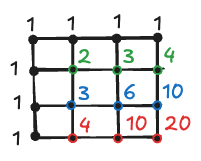
Starting in the top left corner of a \(20 \times 20\) grid, and only being able to move to the right and down, there are exactly \(6\) routes to the bottom right corner.
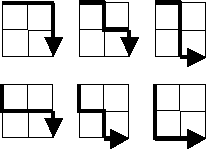
How many such routes are there through a \(20 \times 20\) grid?
Let’s make it easier
When I saw this problem for the first time my first thought was that I probably can calculate it with a pen and paper.
But since we’re coding in Scala here, let’s try to make an application that will solve it for us.
\(20 \times 20\) is a big array, too big to reason about it, while the \(2 \times 2\) is a bit too small. Let’s then draw a \(3 \times 3\) one and mark the edges with dots. How many ways to we have to reach each of these dots? Exactly one way. That was the easiest part.
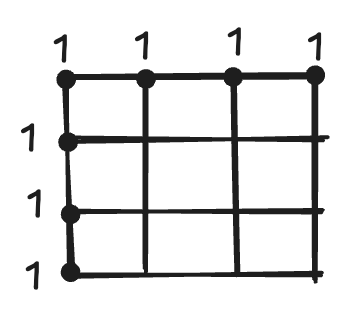
Now let’s try a second row. If we know how to get to the dot above and to the dot on the left side, then we also know how to go to the dot in question, because from their positions there’s just one way to continue (either left or down).
So, we can fill the second row starting from the left side. First dot will be \(1 + 1 = 2\), second will be \(3 + 1 = 3\), third one will be \(3 + 1 = 4\)
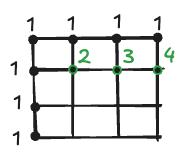
The third row will be no different, let’s continue the process:
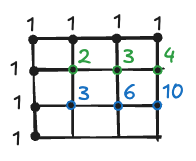
And the same goes for the last one. The answer to a question in how many possible ways we can reach the last lattice can be found in the bottom right corner: 20.
Solution
The previous section shown us some properties of the lattice paths. We can now implement the algorithm that we used.
I went for a functional, recursive solution, but a mutable one that’s based on a simple 2-dimensional Array could do as well.
import scala.annotation.tailrec

object Euler015 extends EulerApp {
  override def execute(): Long = countLatticePaths(21, 21)

  private def countLatticePaths(length: Int, height: Int): Long = {
    val lattice = fillLatticeArray(length, height)
    lattice(length - 1)(height - 1)
  }

  @tailrec
  private def fillLatticeArray(length: Int, height: Int, currentResult: Seq[Seq[Long]] = Seq.empty): Seq[Seq[Long]] =
    currentResult match {
      // First row, we'll fill it with ones
      case Nil =>
        fillLatticeArray(
          length,
          height,
          Seq(Seq.fill(length)(1L))
        )
      // All rows filled, time to finish
      case other if other.size == height => currentResult
      // Filling the next row, but not the first one
      case other =>
        val nextRowNum = currentResult.size
        val previousRow = currentResult(nextRowNum - 1)
        fillLatticeArray(
          length,
          height,
          currentResult :+ previousRow.foldLeft(List.empty) { case (result, previousRowNum) =>
            result :+ result.lastOption.getOrElse(0L) + previousRowNum
          }
        )
    }
}
It does exactly what we did manually, but on a larger scale. It fills the first row and first column with ones, and then it calculates next elements from left to right, top to bottom. The answer is, as before, in the bottom right corner.
It’s a bit robust, but works pretty fast. What could you improve there?
Tip
Before continuing, think about how can we improve the solution. Can we make it more memory efficient? Can we make it faster? Do we calculate something that’s not needed for the answer?
Mutable solution
It’s not a surprise that making it mutable will make it faster. Just keep in mind that in non-algorithmic tasks the performance gainst might be miniscule, completely outweighed by all the downsides of making it mutable.
So, the first change would be to switch the Seq to an Array. What else can we do?
Previously, we stored all the intermediate results and created a complete, large array with all the values. In fact,
we can calculate the next row knowing the previous row. We don’t need to remember all the other ones. Which means that
there’s no need to maintain a 2-dimensional Array.
My first thought was that we need two arrays, for the current and the previous row. Can we use just one?
In the example with four lattices, the second row contained the following values: \(1, 2, 3, 4\)
If we wanted to calculate the third row by mutating the \(1, 2, 3, 4\) one, then:
- Nothing changes for the first element. It stays as one.
- We add the previous element to the next element, that is, \(1 + 2\), and the second element is \(3\). Our row is now \(1, 3, 3, 4\).
- We do the same for the third element, our row is now \(1, 3, 6, 4\)
- And the last element is calculated with \(6 + 4 = 10\), the row is now equal to \(1, 3, 6, 10\)
- For the next row, we do the same again. \(1\) stays unchanged, the second number if \(4\), another one is \(9\), and so on…
In short, now we only need to keep one row in the memory. Here’s the implementation:
object Euler015M extends EulerApp {
  override def execute(): Long = countLatticePaths(21, 21)

  private def countLatticePaths(length: Int, height: Int): Long = {
    val prevRow = Array.fill(length)(1L)

    for (_ <- 1 until height) {
      for (col <- 1 until length) {
        prevRow(col) += prevRow(col - 1)
      }
    }

    prevRow(length - 1)
  }
}
Epilogue
Going forward, we could also use this finding to improve the original, immutable solution. But maybe there’s no need to run this iterative computation at all? If you look at those numbers, they seem to be following a certain pattern.
Power Digit Sum
\(2^{15} = 32768\) and the sum of its digits is \(3 + 2 + 7 + 6 + 8 = 26\).
What is the sum of the digits of the number \(2^{1000}\)?
Solution
Due to the rich standard library in Scala, this problem is extremely easy. We can solve it in one line only!
object Euler016 extends EulerApp {
  override def execute(): Int = BigInt(2).pow(1000).toString().map(_.asDigit).sum
}
It even runs very fast. If we wanted to avoid using BigInt, then it wouldn’t be much harder. We could store the
individual digits in an array and each multiplication would double all the indexes by two. We’d also need to handle
the carrying over.
Still pretty straightforward, not really worth the effort to go through it.
Number Letter Counts
If the numbers \(1\) to \(5\) are written out in words: one, two, three, four, five, then there are \(3 + 3 + 5 + 4 + 4 = 19\) letters used in total.
If all the numbers from \(1\) to \(1000\) (one thousand) inclusive were written out in words, how many letters would be used?
Note: Do not count spaces or hyphens. For example, \(342\) (three hundred and forty-two) contains \(23\) letters and \(115\) (one hundred and fifteen) contains \(20\) letters. The use of “and” when writing out numbers is in compliance with British usage.
Solution
Well, that’s a lot of numbers to cover. Let’s start with something easy, changing one-digit numbers to strings:
private def writeDigit(i: Int): String = i match {
  case 0 => "zero"
  case 1 => "one"
  case 2 => "two"
  case 3 => "three"
  case 4 => "four"
  case 5 => "five"
  case 6 => "six"
  case 7 => "seven"
  case 8 => "eight"
  case 9 => "nine"
  case _ => throw IllegalArgumentException(s"Received unexpected input: $i")
}
Plenty of code, but it’s very straightforward. We could make it more concise by using an Array, but I like this very
explicit pattern match. What’s next? We can write numbers from 10 to 19:
private def writeTenToNineteen(i: Int): String = i match {
  case 10 => "ten"
  case 11 => "eleven"
  case 12 => "twelve"
  case 13 => "thirteen"
  case 14 => "fourteen"
  case 15 => "fifteen"
  case 16 => "sixteen"
  case 17 => "seventeen"
  case 18 => "eighteen"
  case 19 => "nineteen"
  case _  => throw IllegalArgumentException(s"Received unexpected input: $i")
}
There’s not much to simplify there yet, because too many words are irregular. 17 is regular, it consists of “seven” + “teen”, so it might seem appealing to pick the last digit to form a prefix, and add “teen” as a suffix, but due to the fact that it’s not very regular, we’d end up with such oddities as 11 represented as “oneteen” :)
Higher numbers, fortunately, are much more regular. For all the numbers between 20 and 99, we can separate the last
digit from those numbers, convert it to a string using the previously defined writeDigit function, and append it
to a string representation of the two-digit number like 20 or 30. Finally, we can reuse some of our previous functions.
If the number is divisible by 10, then we don’t need the output of writeDigit, or we’ll end up with numbers like
20 being written out as “twenty-zero”.
private def writeTens(i: Int): String = {
  val remainder = i % 10
  val maybeRemainder = if (remainder != 0) Some(writeInt(remainder)) else None
  val tens = i - remainder match {
    case 20 => "twenty"
    case 30 => "thirty"
    case 40 => "forty"
    case 50 => "fifty"
    case 60 => "sixty"
    case 70 => "seventy"
    case 80 => "eighty"
    case 90 => "ninety"
    case _  => throw IllegalArgumentException(s"Received unexpected input: $i")
  }

  maybeRemainder match {
    case Some(digits) => s"$tens-$digits"
    case None         => tens
  }
}
What’s writeInt in the code above? It’s a function that writes any int. That’s where we put the guards not to pass
the int into a function that wouldn’t be able to process it. Right now it looks like that:
private def writeInt(i: Int): String = i match {
  case i if i >= 0 && i < 10     => writeDigit(i)
  case i if i >= 10 && i < 20    => writeTenToNineteen(i)
  case i if i >= 20 && i < 100   => writeTens(i)
}
The last part are the hundreds. They’re the most regular, we’ll be able to reuse almost everything we’ve written so far. A number like 123 consists of:
- Written digit (1), using the
writeDigitfunction - “hundred” word
- Written last two digits, using the
writeIntfunction, since we don’t know if we should usewriteDigit,writeTenToNineteenorwriteTens
And here’s the code for hundreds:
private def writeHundreds(i: Int): String = {
  val remainder = i % 100
  val maybeRemainder = if (remainder != 0) Some(writeInt(remainder)) else None
  val hundred = s"${writeDigit((i - remainder) / 100)} hundred"

  maybeRemainder match {
    case Some(tens) => s"$hundred and $tens"
    case None       => hundred
  }
}
We also need to handle 1000 as “one thousand” and we’re almost done. Here’s the complete solution that convers numbers to strings and counts the letters:
object Euler017 extends EulerApp {
  override def execute(): Any = (1 to 1000)
    .map(writeInt)
    .map(_.count(_.isLetter))
    .sum

  private def writeInt(i: Int): String = i match {
    case i if i >= 0 && i < 10     => writeDigit(i)
    case i if i >= 10 && i < 20    => writeTenToNineteen(i)
    case i if i >= 20 && i < 100   => writeTens(i)
    case i if i >= 100 && i < 1000 => writeHundreds(i)
    case 1000                      => "one thousand"
  }

  private def writeDigit(i: Int): String = i match {
    case 0 => "zero"
    case 1 => "one"
    case 2 => "two"
    case 3 => "three"
    case 4 => "four"
    case 5 => "five"
    case 6 => "six"
    case 7 => "seven"
    case 8 => "eight"
    case 9 => "nine"
    case _ => throw IllegalArgumentException(s"Received unexpected input: $i")
  }

  private def writeTenToNineteen(i: Int): String = i match {
    case 10 => "ten"
    case 11 => "eleven"
    case 12 => "twelve"
    case 13 => "thirteen"
    case 14 => "fourteen"
    case 15 => "fifteen"
    case 16 => "sixteen"
    case 17 => "seventeen"
    case 18 => "eighteen"
    case 19 => "nineteen"
    case _  => throw IllegalArgumentException(s"Received unexpected input: $i")
  }

  private def writeTens(i: Int): String = {
    val remainder = i % 10
    val maybeRemainder = if (remainder != 0) Some(writeInt(remainder)) else None
    val tens = i - remainder match {
      case 20 => "twenty"
      case 30 => "thirty"
      case 40 => "forty"
      case 50 => "fifty"
      case 60 => "sixty"
      case 70 => "seventy"
      case 80 => "eighty"
      case 90 => "ninety"
      case _  => throw IllegalArgumentException(s"Received unexpected input: $i")
    }

    maybeRemainder match {
      case Some(digits) => s"$tens-$digits"
      case None         => tens
    }
  }

  private def writeHundreds(i: Int): String = {
    val remainder = i % 100
    val maybeRemainder = if (remainder != 0) Some(writeInt(remainder)) else None
    val hundred = s"${writeDigit((i - remainder) / 100)} hundred"

    maybeRemainder match {
      case Some(tens) => s"$hundred and $tens"
      case None       => hundred
    }
  }
}
Epilogue
Was it necessary to convert everything to a string? Not at all. We were asked to count the letters only, so if we wanted to be more efficient, the pattern matching could look like that:
case 8 => 5
There are \(5\) letters in the word “eight”. There’s one problem with that approach. Debugging it would be a nightmare. It would be not reusable for anything. The program runs fast already, after all.
There’s one improvement that we could make, though. Those cases aren’t good:
case _ => throw IllegalArgumentException(s"Received unexpected input: $i")
Due to them, our functions aren’t pure. They have a very nasty side effect. Even though they all accept Int parameter,
they can only operate on a subset of numbers. That’s a risky, error-prone design. A much better solution would use
refined types. For example, a separate Digit type that could be only created from numbers 0 to 9. Such types can be
also checked by compiler, so a Digit(10) throws a compilation error rather than a runtime exception.
Maximum Path Sum I
By starting at the top of the triangle below and moving to adjacent numbers on the row below, the maximum total from top to bottom is \(23\).
3
7 4
2 4 6
8 5 9 3
That is, \(3 + 7 + 4 + 9 = 23\).
Find the maximum total from top to bottom of the triangle below:
75
95 64
17 47 82
18 35 87 10
20 04 82 47 65
19 01 23 75 03 34
88 02 77 73 07 63 67
99 65 04 28 06 16 70 92
41 41 26 56 83 40 80 70 33
41 48 72 33 47 32 37 16 94 29
53 71 44 65 25 43 91 52 97 51 14
70 11 33 28 77 73 17 78 39 68 17 57
91 71 52 38 17 14 91 43 58 50 27 29 48
63 66 04 68 89 53 67 30 73 16 69 87 40 31
04 62 98 27 23 09 70 98 73 93 38 53 60 04 23
NOTE: As there are only \(16384\) routes, it is possible to solve this problem by trying every route. However, Problem 67, is the same challenge with a triangle containing one-hundred rows; it cannot be solved by brute force, and requires a clever method! ;o)
Let’s make it easier
We could indeed try to brute-force it, but I did not come up with any elegant brute-force in terms of implementation, so I’ve decided to instead think about solving this problem the ‘intended way’. As usual, let’s think about a nice algorithm that will save us from the necessity of checking all these possibilities. The small triangle will be perfect to plan it.
3
7 4
2 4 6
8 5 9 3
Instead of plotting a route from the top, we could try to do it from the bottom. Can we do something with the last row? Not really. We can’t take the maximum since we don’t know what’s ahead of us, exactly as if we started from the top.
Moving to the row before last, that is, \(2 4 6\), we notice that each of those numbers have exactly two children-numbers. For \(2\), that will be \(8\) and \(5\), for 4, it is \(5\) and \(9\), and so on. If our question was to find the best path for those small sub-problems, with 3-number triangles, then naturally we’d simply pick the bigger children. We can then add it to the parent. That’s how the triangle now looks like:
3
7 4
10 13 15
We can do the same folding to the next row. Just need to pick the “bigger” children. Eventually we’ll end up with that:
3
20 19
And then we fold it once again, leaving us with a single value: \(23\). That’s the maximum path sum.
Solution
For a big triangle, the algorithm remains exactly the same. A natural way to implement it is to mutate the arrays that represent the subsequent rows.
object Euler018M extends EulerApp {
  override def execute(): Int = {
    val dataArray: Array[Array[Int]] = prepareData()
    var rowIndex = dataArray.length - 2

    while (rowIndex >= 0) {
      dataArray(rowIndex).zipWithIndex.foreach { case (value, columnIndex) =>
        val childrenRow = dataArray(rowIndex + 1)
        val maxChildValue = Math.max(childrenRow(columnIndex), childrenRow(columnIndex + 1))
        dataArray(rowIndex)(columnIndex) = dataArray(rowIndex)(columnIndex) + maxChildValue
      }
      rowIndex -= 1
    }

    dataArray.head.head
  }

  private def prepareData(): Array[Array[Int]] =
    loadFileAsLines().toArray.map(_.split(" ").map(_.toInt).toArray)
}
Very straightforward to implement, as it closely follows what we did on paper with the small triangle, but
unfortunately it mutates both the dataArray and the rowIndex.
For an immutable solution, we need to fold our triangle from the bottom. We can represent it as a
List[List[Int]] and reverse it so we start from the end.
val reversedData = prepareData().reverse
reversedData.tail.foldLeft(reversedData.head) { case (previousRow, currentRow) => ... }
This part starts from the second row (.tail), while the first one goes into the accumulator. Since we always have two
rows available, all we need to do is pick the bigger child and build the next accumulator, which will be our
new previousRow. Here’s the complete solution:
object Euler018 extends EulerApp {
  override def execute(): Int = {
    val reversedData = prepareData().reverse
    reversedData.tail
      .foldLeft(reversedData.head) { case (previousRow, currentRow) =>
        currentRow.zipWithIndex.map { case (element, index) =>
          element + Math.max(previousRow(index), previousRow(index + 1))
        }
      }
      .head
  }

  private def prepareData(): List[List[Int]] =
    loadFileAsLines().map(_.split(" ").map(_.toInt).toList)
}
That’s it! Very concise, fully functional and with a similar run time.
Counting Sundays
You are given the following information, but you may prefer to do some research for yourself.
- 1 Jan 1900 was a Monday.
- Thirty days has September,
April, June and November.
All the rest have thirty-one,
Saving February alone,
Which has twenty-eight, rain or shine.
And on leap years, twenty-nine. - A leap year occurs on any year evenly divisible by 4, but not on a century unless it is divisible by 400. How many Sundays fell on the first of the month during the twentieth century (1 Jan 1901 to 31 Dec 2000)?
How many Sundays fell on the first of the month during the twentieth century (1 Jan 1901 to 31 Dec 2000)?
Solution
I’m afraid there’s no clever way to solve this without writing plenty of code. On the other hand, this problem is pretty straightforward; all we need is some domain modelling. Let’s do it then.
We can start by encoding some simple facts about the calendar. We need to know how many days are in a given month, as well as if the year is leap or not. Let’s also add two helper functions to let us quickly check the century:
private type Year = Int

private def daysPerMonth(year: Year): Array[Int] = Array(
  31, // January
  if (isLeapYear(year)) 29 else 28, // February
  31, // March
  30, // April
  31, // May
  30, // June
  31, // July
  31, // August
  30, // September
  31, // October
  30, // November
  31 // December
)

private def isLeapYear(year: Year): Boolean =
  (year % 4 == 0) && (year % 100 != 0 || year % 400 == 0)

def isInTwentiethCentury: Boolean = year >= 1901 && year <= 2000

def isInTwentyFirstCentury: Boolean = year >= 2001
Having those facts laid out, we can try constructing a crude model of a calendar:
case class Calendar(
     dayNumber: Int,
     dayOfWeekNumber: Int,
     monthNumber: Int,
     year: Year
 )
In this case:
dayNumberrepresents a number of a day in a month, as in June 10dayOfWeekNumberis an internal counter for a day of the week, 0 being Monday and 6 SundaymonthNumberis a number of the month, 0 being Januaryyearis a year type that we’ve defined before
Our calendar needs a way to progress the day while keeping the state of other variables consistent.
It’s not difficult since we have some data to use. Once the dayOfWeekNumber reaches 7 we go back to 0.
Every time we reach a day that’s higher than the daysPerMonth(year)(monthNumber), we either progress the month
or a whole year if we’re at the last month (11 on our case, since we count from 0).
If neither of these checks is met, we simply progress the day.
def nextDay(): Calendar = {
  val newDay = dayNumber + 1
  val newDayOfWeek = if (dayOfWeekNumber + 1 == 7) 0 else dayOfWeekNumber + 1

  if (newDay > daysPerMonth(year)(monthNumber)) {
    if (monthNumber == 11) Calendar(1, newDayOfWeek, 0, year + 1)
    else Calendar(1, newDayOfWeek, monthNumber + 1, year)
  } else Calendar(newDay, newDayOfWeek, monthNumber, year)
}

val dayOfWeek: DayOfWeek = daysOfWeek(dayOfWeekNumber)

val isSunday: Boolean = dayOfWeekNumber == 6
And that’s all we need to calculate it. The condition that we’ll be checking is pretty simple:
if (calendar.isSunday && calendar.dayNumber == 1)
If it’s met, then we’ve found the Sunday we’re looking for. If not, we progress the calendar further, until
(calendar.isInTwentyFirstCentury) – that’s the termination condition.
Here’s the whole code:
import scala.annotation.tailrec

object Euler019 extends EulerApp {

  private type DayOfWeek = String
  private type Year = Int

  override def execute(): Any = {
    @tailrec
    def sundaysInTwentyCentury(calendar: Calendar, sundays: Int): Int = {
      if (calendar.isInTwentyFirstCentury) sundays
      else if (calendar.isInTwentiethCentury) {
        val newSundays =
          if (calendar.isSunday && calendar.dayNumber == 1) sundays + 1 else sundays
        sundaysInTwentyCentury(calendar.nextDay(), newSundays)
      } else sundaysInTwentyCentury(calendar.nextDay(), sundays)
    }

    sundaysInTwentyCentury(Calendar.StartDate, 0)
  }

  case class Calendar(
      dayNumber: Int,
      dayOfWeekNumber: Int,
      monthNumber: Int,
      year: Year
  ) {
    private def daysPerMonth(year: Year): Array[Int] = Array(
      31, // January
      if (isLeapYear(year)) 29 else 28, // February
      31, // March
      30, // April
      31, // May
      30, // June
      31, // July
      31, // August
      30, // September
      31, // October
      30, // November
      31 // December
    )

    private def isLeapYear(year: Year): Boolean =
      (year % 4 == 0) && (year % 100 != 0 || year % 400 == 0)

    def nextDay(): Calendar = {
      val newDay = dayNumber + 1
      val newDayOfWeek = if (dayOfWeekNumber + 1 == 7) 0 else dayOfWeekNumber + 1

      if (newDay > daysPerMonth(year)(monthNumber)) {
        if (monthNumber == 11) Calendar(1, newDayOfWeek, 0, year + 1)
        else Calendar(1, newDayOfWeek, monthNumber + 1, year)
      } else Calendar(newDay, newDayOfWeek, monthNumber, year)
    }

    val isSunday: Boolean = dayOfWeekNumber == 6

    def isInTwentiethCentury: Boolean = year >= 1901 && year <= 2000

    def isInTwentyFirstCentury: Boolean = year >= 2001
  }

  object Calendar {
    val StartDate: Calendar = Calendar(dayNumber = 1, dayOfWeekNumber = 0, monthNumber = 0, year = 1900)
  }
}
Mutable solution
While reading the previous solution you might be thinking… why don’t we just use the standard library? Indeed, we can!
In fact, this problem is completely trivialized once we do so. We can simply encode the start date and the end date,
the condition is easily expressed with API for java.time.LocalDate.
import java.time.{DayOfWeek, LocalDate}

object Euler019M extends EulerApp {
  override def execute(): Int = {
    val endDate = LocalDate.of(2000, 12, 31)
    var currentDate = LocalDate.of(1901, 1, 1)
    var sundays = 0

    while (currentDate.isBefore(endDate)) {
      if (currentDate.getDayOfMonth == 1 && currentDate.getDayOfWeek == DayOfWeek.SUNDAY) sundays += 1
      currentDate = currentDate.plusDays(1)
    }

    sundays
  }
}
Easier, cleaner, better. But in this case, most of the information present in the problem description is not used. We don’t need to check if the year is leap or how many days are in a month. In any project using the standard library would be obviously the way to go, but since we’re just practicing, it makes sense to try to attempt doing it ourselves.
Factorial Digit Sum
\(n!\) means \(n \times (n - 1) \times … \times 3 \times 2 \times 1\).
For example, \(10! = 10\times 9 \times … \times 3 \times 2 \times 1 = 3628800\), and the sum of the digits in the number \(10!\) is \(3 + 6 + 2 + 8 + 8 + 0 + 0 = 27\).
Find the sum of the digits in the number \(100!\).
Solution
Thanks to Scala’s extensive standard library, we can represent the factorial in question as a regular
BigInt. It even has a convenient .factorial method.
Once we have the result of \(100!\), we can recursively read it, digit by digit, using the modulo division.
import EulerHelper.*

import scala.annotation.tailrec

object Euler020 extends EulerApp {
  override def execute(): Any = {
    sumDigits(BigInt(100).factorial)
  }

  @tailrec
  private def sumDigits(n: BigInt, result: BigInt = 0): BigInt =
    if (n == 0) result
    else sumDigits(n / 10, result + n % 10)
}
Amicable Numbers
Let \(d(n)\) be defined as the sum of proper divisors of \(n\) (numbers less than \(n\) which divide evenly into \(n\). If \(d(a) = b\) and \(d(b) = a\), where \(a \neq b\), then \(a\) and \(b\) are an amicable pair and each of \(a\) and \(b\) are called amicable numbers.
For example, the proper divisors of \(220\) are \(1,2,4,5,10,11,20,22,44,55\) and \(110\); therefore \(d(220) = 284\). The proper divisors of \(284\) are \(1,2,4,71\) and \(142\); so \(d(284) = 220\).
Evaluate the sum of all the amicable numbers under \(10000\).
Let’s make it easier
First thing to crack is how to calculate the divisors efficiently. Should we use prime factors? Perhaps, but as a rule of thumb I always start with a simpler approach and move on to a more advanced one if the simple one is not good enough.
If we wanted to find all the divisors of 220, how many numbers do we need to check? We can check from \(2\) to \(110 (220 / 2))), but there’s a better way. Logically, if \(220\) is divisible by \(2\) and we get 110 as a result, then it must be divisible by \(110\) as well. That’s a strong hint that we don’t need to check all the numbers.
How many do we need to check? \(220\) isn’t a great example, so, let’s switch to \(100\), this will be more intuitive. We know that it’s divisible by \(2\), the result of the division is \(50\). We have our first two divisors. Next divisor is \(4\), the result is \(25\). Now we have four divisors: \(2, 4, 25, 50).
Next divisor is \(5\) and \(20\), because \(100 ÷ 5 = 20\). Another one is \(10\). Now that’s a pretty interesting coincidence, that \(100 ÷ 10\) is also \(10\). We no longer have two numbers, just one. Something to keep in mind when designing the algorithm.
Do we need to check further? Let’s pretend that 100 is divisible by \(11\). Obviously it isn’t, but let’s just pretend for a while! In order to get the second number we’d divide \(100\) by \(11\) and it would be a number smaller than \(10\). Which means that it’s a number that we should’ve already found before. The conclusion is, then, that we don’t need to check anything past \(10\).
\(10\) is a square root of \(100\). As long as we keep adding two divisors at once, there’s no need to go past the square root.
Solution
Let’s try to write a function that calculates the divisors based on our previous findings. We also need to keep in mind that every number is divisible by one, so we can start the iteration from \(2\).
private def divisors(n: Int): Seq[Int] = 1 +: (2 to Math.sqrt(n).toInt).flatMap {
  case i if n % i == 0 => if (i != n / i) List(i, n / i) else List(i)
  case _ => List()
}
The code above does exactly what was described before. If i is a divisor, n % i == 0, then we’ve found two of them,
the: List(i, n / i).
We’re not very close to the complete solution. All we have to do left is to calculate the sum of divisors of numbers under \(10000\), then use that information to find the amicable numbers.
object Euler021 extends EulerApp {
  override def execute(): Any = {
    val divisorSums = (0 to 10000).map(n => divisors(n).sum)
    divisorSums.zipWithIndex.collect {
      case (sum, index) if sum < 10000 && sum != index && index == divisorSums(sum) =>
        index
    }.sum
  }

  private def divisors(n: Int): Seq[Int] = 1 +: (2 to Math.sqrt(n).toInt).flatMap {
    case i if n % i == 0 => if (i != n / i) List(i, n / i) else List(i)
    case _ => List()
  }
}
In my solution, I’m storing the sum of divisors in a Seq, where Seq(1) represents the sum of divisors of 1.
If you think about the signature of divisors(n: Int): Seq[Int], we don’t need to return the Seq[Int] at all here.
We’re interested in the sum, so Int is enough. But with sums alone, debugging would get much more difficult if you
made a mistake in calculating the divisors. It’s up to you though.
In the end, the current solution is pretty fast, so we can stop here and keep it as it is.
Names Scores
Using names.txt, a 46K text file containing over five-thousand first names, begin by sorting it into alphabetical order. Then working out the alphabetical value for each name, multiply this value by its alphabetical position in the list to obtain a name score.
For example, when the list is sorted into alphabetical order, COLIN, which is worth \(3 + 15 + 12 + 9 + 14 = 53\), is the \(938th\) name in the list. So, COLIN would obtain a score of \(938 \times 53 = 49714\).
What is the total of all the name scores in the file?
Solution
It’s a rather easy problem due to a small dataset. No need to use any tricks to solve it.
When processing the names we need to remove the quotation marks that appear as the first and the last character:
name => name.slice(1, name.length - 1)
Here’s the complete solution:
object Euler022 extends EulerApp {
  override def execute(): Any =
    loadFileAsLines()
      .flatMap(_.split(","))
      .view
      .map(name => name.slice(1, name.length - 1))
      .sorted
      .zipWithIndex
      .map { case (name, index) =>
        name.map(c => (c - 'A') + 1).sum * (index + 1)
      }
      .sum
}
The score calculating part might look a bit enigmatic, so I’ll give a couple words of explanation:
.zipWithIndex
.map { case (name, index) =>
  name.map(c => (c - 'A') + 1).sum * (index + 1)
}
The c here is a character, like A, and if we remove A from it then we get 0. So we need to add 1 to it, since A
is the first letter of the alphabet. Once we get this score, it needs to be multiplied by (index + 1) because the name
indices start from 0. Score of the first name needs to be multiplied by 1, not 0.
Non-Abundant Sums
A perfect number is a number for which the sum of its proper divisors is exactly equal to the number. For example, the sum of the proper divisors of \(28\) would be \(1 + 2 + 4 + 7 + 14 = 28\), which means that \(28\) is a perfect number.
A number \(n\) is called deficient if the sum of its proper divisors is less than \(n\) and it is called abundant if this sum exceeds \(n\).
As \(12\) is the smallest abundant number, \(1 + 2 + 3 + 4 + 6 = 16\), the smallest number that can be written as the sum of two abundant numbers is \(24\). By mathematical analysis, it can be shown that all integers greater than \(28123\) can be written as the sum of two abundant numbers. However, this upper limit cannot be reduced any further by analysis even though it is known that the greatest number that cannot be expressed as the sum of two abundant numbers is less than this limit.
Find the sum of all the positive integers which cannot be written as the sum of two abundant numbers.
Solution
We can obtain the divisors by reusing the code from Problem 21:
private def divisors(n: Int): Seq[Int] = 1 +: (2 to Math.sqrt(n).toInt).flatMap {
  case i if n % i == 0 => if (i != n / i) List(i, n / i) else List(i)
  case _               => List()
}
Now it is easy to check whether a number is abundant. Simply compare the sum of its divisors with the number itself:
private def isAbundant(n: Int): Boolean = divisors(n).sum > n
But how do we tell if a number is the sum of two abundant numbers? Checking all possibilities would be inefficient. In the worst case, we would need to check every pair of numbers, which leads to \(O(n^2))\) complexity. But there’s a way to make it linear!
If we subtract an abundant number \(a\) of ouf the number \(n\) we’re checking, then we only need to see whether
the different is also abundant. There is one problem, however, with our simple isAbundant method. It recomputes the
divisors every time, which is wasteful.
Once we know all the abundant numbers within a given range, we determine whether a number is abundant
(within that range) by simply checking if it’s inside the set of known abundant numbers.
The wording here is crucial, string Set rather than a List to do that search is crucial.
Here’s the complete solution:
object Euler023 extends EulerApp {
  override def execute(): Any = {
    val limit = 28123
    val abundantNumbers = (1 to limit).filter(isAbundant)
    val abundantNumbersSet = abundantNumbers.toSet
    (1 to limit).filterNot { n =>
      isSumOfTwoAbundant(n, abundantNumbers, abundantNumbersSet)
    }.sum
  }

  private def isSumOfTwoAbundant(
      n: Int,
      abundantNumbers: Seq[Int],
      abundantNumbersSet: Set[Int]
  ): Boolean =
    abundantNumbers.takeWhile(_ <= n).exists { a =>
      abundantNumbersSet.contains(n - a)
    }

  private def isAbundant(n: Int): Boolean = divisors(n).sum > n

  private def divisors(n: Int): Seq[Int] = 1 +: (2 to Math.sqrt(n).toInt).flatMap {
    case i if n % i == 0 => if (i != n / i) List(i, n / i) else List(i)
    case _               => List()
  }
}
On my notebook it runs in less than a second.
Lexicographic Permutations
A permutation is an ordered arrangement of objects. For example, \(3124\) is one possible permutation of the digits \(1, 2, 3\) and \(4\). If all of the permutations are listed numerically or alphabetically, we call it lexicographic order. The lexicographic permutations of \(0\), \(1\) and \(2\) are:
\begin{align} 012, 021, 102, 120, 201, 210 \end{align}
What is the millionth lexicographic permutation of the digits \(0, 1, 2, 3, 4, 5, 6, 7, 8\) and \(9\)?
Solution
Scala’s standard library is so good that this problem can be solved in just a single line.
The .permutations create permutations, already in lexicographic order, so we just need to find the millionth one.
object Euler024 extends EulerApp {
  override def execute(): String = "0123456789".permutations.drop(999_999).next()
}
It’s all Iterator-based, which means that there’s no need to store all the million permutations in the memory.
Perfectly readable and efficient. I wish all problems could be solved like that!
1000-digit Fibonacci Number
The Fibonacci sequence is defined by the recurrence relation:
\(F_n = F_{n - 1} + F_{n - 2}\), where \(F_1 = 1\) and \(F_2 = 1\)
Hence, the first 12 terms will be:
\begin{align} F_1 &= 1\\ F_2 &= 1\\ F_3 &= 2\\ F_4 &= 3\\ F_5 &= 5\\ F_6 &= 8\\ F_7 &= 13\\ F_8 &= 21\\ F_9 &= 34\\ F_{10} &= 55\\ F_{11} &= 89\\ F_{12} &= 144 \end{align}
The \(12th\) term, \(F_{12}\), is the first term to contain three digits.
What is the index of the first term in the Fibonacci sequence to contain \(1000\) digits?
Solution
This problem doesn’t need any optimizations to be solved in milliseconds. It’s perfectly fine to store 1000-digit
numbers within a BigInt, so we can just keep getting new Fibonacci sequence numbers until the result hits 1000 digits.
import scala.annotation.tailrec

object Euler025 extends EulerApp {
  override def execute(): Any = fibonacciDigits(1000)

  def fibonacciDigits(digitsLimit: Int): BigInt = {
    @tailrec
    def fibonacci(p1: BigInt, p2: BigInt, current: BigInt, index: Int): BigInt =
      if (current.toString.length == digitsLimit) index
      else fibonacci(p2, current, p2 + current, index + 1)

    fibonacci(1, 1, 2, 3)
  }
}
Pen and paper solution
We could stop there and call it a day, but this problem can be solved in a different way if we dive deep into one curious property of the Fibonacci sequence.
The golden ratio
There’s an irrational number, called golden ratio and denoted with a Greek letter phi \(\phi\). It’s equal to \(\frac{1 + \sqrt{5}}{2}\), which is approximately \(1.6180339887…\)
It turns out, that once we divide Fibonacci sequence element with its previous element, we’ll get closer to the golden ratio as we go.
\begin{align} 13 ÷ 8 &= 1.625\\ 21 ÷ 13 &= 1.61538462\\ 34 ÷ 21 &= 1.61904762\\ … \end{align}
It can be also represented graphically. I won’t write too much about it. I’m not a mathematician, and I’m sure there are places where this is explained much better.
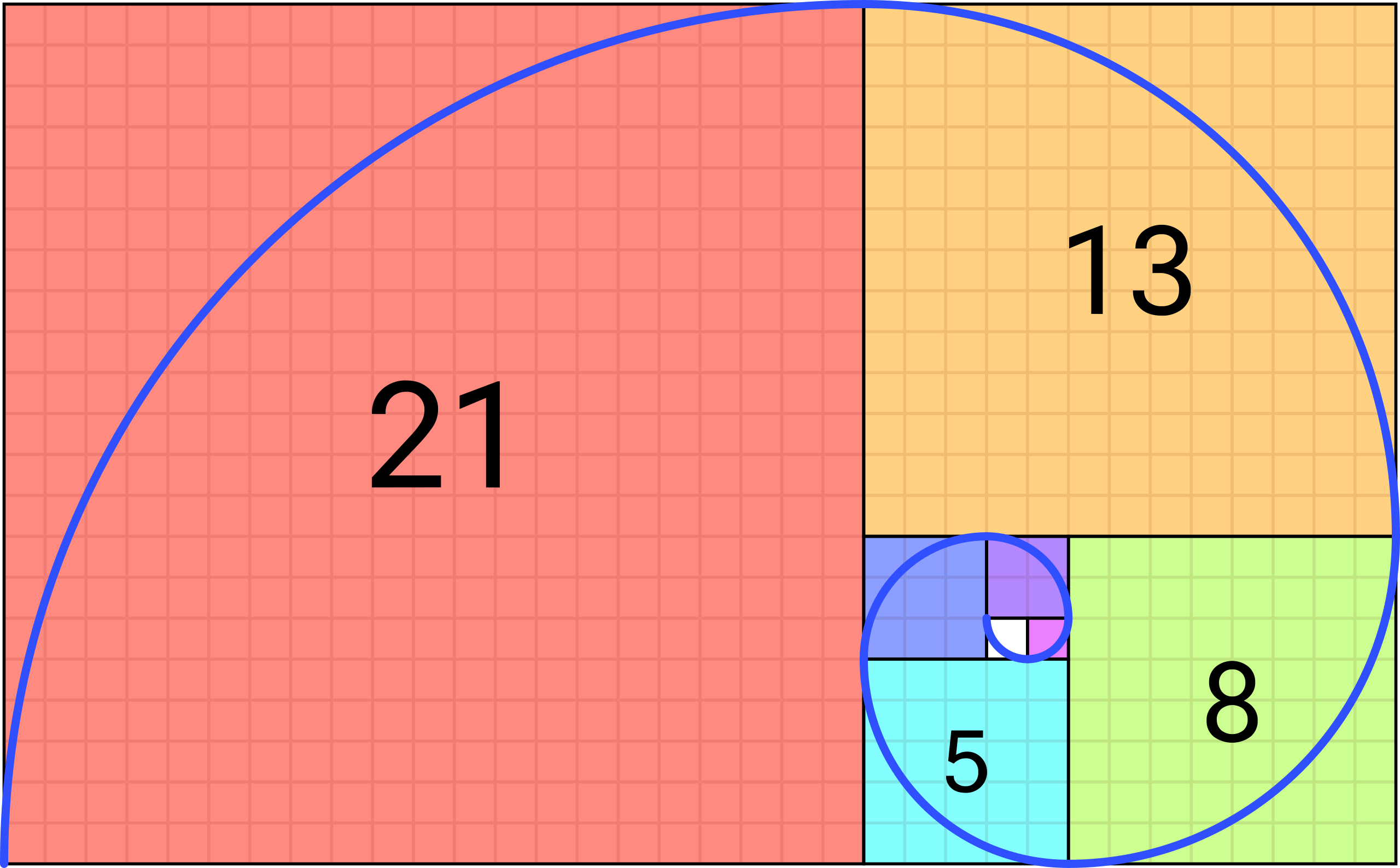
The most important information is, that for a very large number, we can use this formula to calculate the \(nth\) element of the Fibonacci sequence.
\begin{align} Fib(n) = round(\frac{\phi^n}{\sqrt{5}} ), where\ \phi = (\frac{1 + \sqrt{5}}{2}) \end{align}
That’s called progress! We are now free from calculating the previous elements of the Fibonacci sequence.
Logarithm and the digits
We’ll now use an interesting property of logarithms to find the number of digits of a very large number.
Logarithm of base 10, that is, \(log_{10}(x)\), lets us calculate to what power must 10 be raised to obtain the number \(x\).
So, \(log_{10}(100)\) is \(2\), because \(10^2 = 100\).
What about \(log_{10}(1000)\)? It’s \(3\), \(10^3 = 1000\).
We’re off by one it seems. So… what about \(log_{10}(999)\)? It’s \(2,99956549\), which is almost 3.
Using this property, we can tell how many digits a number has. We calculate the logarithm, floor the result, and add one. Doing so for our first example, \(log_{10}(100)\), would return 3.
Tip
Logarithms of base 10 are called common logarithms. From now on we’ll denote them simply as “log”
In our case, we want to find a number that has 1000 digits. \(10^{999}\) is the first number that has \(1000\) digits, so the number we’re looking for should be equal or greater than that.
Combining everything mentioned before, we can describe our problem with this equation:
\begin{align} log_{10}(\frac{\phi^n}{\sqrt{5}}) \geq 999\\ n log_{10}(\phi) - log_{10}(\sqrt{5}) \geq 999\\ n \geq \frac{999 + log_{10}(\sqrt{5})}{log_{10}(\phi)} \end{align}
At this point we can just calculate these logarithms and substitute the values in our original equation: \begin{align} log_{10}(\sqrt{5}) \approx 0.349485\\ log_{10}(\phi) \approx 0.208988 \end{align}
After substituting:
\begin{align} n \geq \frac{999 + 0.349485}{0.208988}\\ n \geq \frac{999.349485}{0.208988}\\ n \geq \frac{999.349485}{0.208988}\\ n \geq 4781.851039 \end{align}
We floor it and add 1, which gives us the result of 4782.
Reciprocal Cycles
A unit fraction contains \(1\) in the numerator. The decimal representation of the unit fractions with denominators \(2\) to \(10\) are given:
\begin{align} 1/2 &= 0.5\\ 1/3 &=0.(3)\\ 1/4 &=0.25\\ 1/5 &= 0.2\\ 1/6 &= 0.1(6)\\ 1/7 &= 0.(142857)\\ 1/8 &= 0.125\\ 1/9 &= 0.(1)\\ 1/10 &= 0.1 \end{align}
Where \(0.1(6)\) means \(0.166666\cdots\), and has a \(1\)-digit recurring cycle. It can be seen that \(1/7\) has a \(6\)-digit recurring cycle.
Find the value of \(d \lt 1000\) for which \(1/d\) contains the longest recurring cycle in its decimal fraction part.
Naive solution (dead end)
The problem is a bit tricky because it’s hard to imagine a naive solution that performs poorly and can then be improved upon. In this case, that’s not really possible.
Calculating the decimal representation of a fraction using standard division alone won’t work because of precision limitations.
Using a BigDecimal might seem like an improvement, but then we run into the problem of detecting the recurring cycle. And that’s only the beginning. Consider the following code:
val mathContext = new MathContext(100, RoundingMode.HALF_EVEN)
BigDecimal(1, mathContext) / BigDecimal(7)
This returns a very long number:
\(0.1428571428571428571428571428571428571428571428571428571428571428571428571428571428571428571428571429\)
In theory, we could find the cycle by performing many lookups on this representation, but that wouldn’t be very efficient.
What’s worse, the choice of 100 decimal places was arbitrary. In this case, it overshoots the required precision considerably. More importantly, we have no way of knowing in advance how many digits will be needed for a different fraction.
That’s a very hacky, dirty solution. There must be a better way!
Solution
My other idea was inspired by a pen and paper division. If we wanted to divide 1 by 7 by hand, it would be an iterative process, where each step requires one division, remembering the remainder and writing down the next decimal number.
So, for 1 / 7, we would have the following steps:
- 10 / 7 -> writing down 1, remainder is (10 - 7) = 3
- 30 / 7 -> writing down 4, remainder is (30 - 28) = 2
- 20 / 7 -> writing down 2, remainder is (20 - 14) = 6
- 60 / 7 -> writing down 8, remainder is (60 - 56) = 4
- 40 / 7 -> writing down 5, remainder is (40 - 35) = 5
- 50 / 7 -> writing down 7, remainder is (50 - 49) = 1
- 10 / 7 -> ugh, this looks familiar. Right! That’s a cycle.
It means that our solutions needs to keep track of how deep the cycle is (its length) and the previous remainders. If we already processed the remainder before, then it’s a cycle.
There are also cases like 1 / 6, where the cycle starts at the second number, so instead of storing just the remainder, let’s also store the index to see where the cycle starts. Here’s one way of doing that:
import scala.annotation.tailrec

object Euler026 extends EulerApp {
  override def execute(): Any = (1 until 1000).maxBy(findCycleLength)

  private type Index = Int
  private type Remainder = Int

  private def findCycleLength(divisor: Int): Int = {

    @tailrec
    def findCycleLength(remainder: Int, pastResults: Map[Remainder, Index]): Int = {
      pastResults.get(remainder) match {
        // If it's in the map, then we've found the cycle
        case Some(index) => pastResults.size - index
        case None        =>
          remainder match {
            case 0                        => 0
            case r if remainder < divisor =>
              val newRemainder = remainder * 10
              findCycleLength(newRemainder, pastResults + (remainder -> pastResults.size))
            case r =>
              val newRemainder = (remainder % divisor) * 10
              findCycleLength(
                newRemainder,
                pastResults + (remainder -> pastResults.size)
              )
          }
      }
    }

    findCycleLength(remainder = 1 % divisor, pastResults = Map.empty)
  }
}
The implementation itself is pretty straightforward. There’s nothing worth discussing that wasn’t covered before, as it’s a standard tail recursive solution, that could’ve been a simple loop in other languages. d
Quadratic Primes
Euler discovered the remarkable quadratic formula:
\begin{align} n^{2} + n + 41 \end{align}
It turns out that the formula will produce \(40\) primes for the consecutive integer values \(0 \leq n \leq 39\). However, when \(n = 40, 40^{2} + 40 + 41 = 40(40 + 1) + 41\) is divisible by \(41\), and certainly when \(n = 41, 41^{2} + 41 + 41\) is clearly divisible by \(41\).
The incredible formula \(n^{2} - 79n + 1601\) was discovered, which produces \(80\) primes for the consecutive values \(0 \leq n \leq 79\). The product of the coefficients, \(-79\) and \(1601\), is \(-126479\).
Considering quadratics of the form:
\(n^2 + an + b\), where \(|a| < 1000\) and \(|b| \leq 1000\)
e.g. \(|11| = 11\) and \(|-4| = 4\)
Find the product of the coefficients, \(a\) and \(b\), for the quadratic expression that produces the maximum number of primes for consecutive values of \(n\), starting with \(n = 0\) .
Solution
That’s a long problem description for a relatively easy task. It looks daunting, but in reality it’s quite simple.
We need to find a and b for which the consecutive values of n produce the largest amount of primes.
Because the constraints are relatively low, we don’t need to optimize much, a brute-force solution will work just fine.
Oh well, maybe let’s just do one! Take a look at the formula here: \(n^2 + an + b\)
Try substituting n and think if you can spot a certain property of a or b that can limit what we need to check.
Can you see it? Hint, try: n = 0
If the n = 0, then we’re left with just b. It means that if we’re looking for consecutive values of primes,
the first prime must be a number when n = 0, and in the formula there’s just b. So, b must be a prime!
import EulerHelper.naiveIsPrime

object Euler027 extends EulerApp {

  override def execute(): Int = {
    val coefficients = for {
      a <- -999 until 1000
      b <- 2 to 1000 if b.naiveIsPrime
    } yield (a, b)

    val (a, b) = coefficients.maxBy { case (a, b) =>
      consecutivePrimes(a, b)
    }

    a * b
  }

  private def consecutivePrimes(a: Int, b: Int): Int =
    Iterator.from(0).takeWhile { n =>
      (n * n + n * a + b).naiveIsPrime
    }.length

}
Final notes
The solution works relatively fast. If we had longer prime sequences, this part could’ve been a bit troublesome:
Iterator.from(0).takeWhile { n =>
  (n * n + n * a + b).naiveIsPrime
}.length
As you can see, we check .length at the very end, meaning that all the primes are collected to a list. That’s
not what we need, right? To keep it clean, one could write a small helper like this one:
extension[A] (i: Iterator[A]) {
  private def countWhile(f: A => Boolean): Int = {
    var count = 0
    while (i.hasNext && f(i.next())) {
      count += 1
    }
    count
  }
}
Number Spiral Diagonals
Starting with the number \(1\) and moving to the right in a clockwise direction a \(5\) by \(5\) spiral is formed as follows:
It can be verified that the sum of the numbers on the diagonals is \(101\).
What is the sum of the numbers on the diagonals in a \(1001\) by \(1001\) spiral formed in the same way?
Solution
In that kind of problems I usually try to figure out the formula of how the numbers increase. We could try to draw the whole array, but Project Euler problems aren’t about brute strength. Let’s try it!
The first fact: all sums of the diagonals will eventually end up in the middle, where we have 1. So, we’ll always need to add 1 to our result.
Each “layer” of the array grows proportionally. They always have 4 numbers on each diagonal.
On the first “layer”, the outermost numbers of the 3x3 spiral, we have: \(3, 5, 7, 9\).
On the next one, for a 5x5 spiral: \(13, 17, 21, 25\). Is there any pattern they follow?
There are always 4 numbers, and they increase linearly.
In the 3x3 spiral, they increase by 2.
In a 5x5 spiral, they increase by 4.
If you draw a 7x7 spiral, you could see that they increase by 6. It’s kind of logical, that the increase depends on the length of the spiral: it’s just length - 1.
What about the initial number? What I noticed is that for a 3x3 spiral, the biggest number is 9.
For a 5x5 spiral it’s 25. That looks like a square. So, if we use n for the length of the spiral, the numbers that
it’s composed of are as follows:
- n * n
- n * n - (n - 1)
- n * n - 2 * (n - 1)
- n * n - 3 * (n - 1)
All we need to do is to substitute the n with the spiral length, starting from 3. We increase n by two until we
hit 1001. And don’t forget about the initial 1.
object Euler028 extends EulerApp {

  override def execute(): Long = {
    1 + Iterator
      .from(3, 2)
      .takeWhile(_ <= 1001)
      .map(sumForDiagonal)
      .sum
  }

  private def sumForDiagonal(n: Int): Int = {
    n * n +
      n * n - (n - 1) +
      n * n - 2 * (n - 1) +
      n * n - 3 * (n - 1)
  }
}
That’s all. The solution is pretty neat, it does exactly what we did in a pen and paper approach.
Distinct Powers
Consider all integer combinations of \(a^{b}\) for \(2 \leq a \leq 5\) and \(2 \leq b \leq 5\):
\begin{array}{rrrr} 2^{2}=4, &2^{3}=8, &2^{4}=16, &2^{5}=32\\ 3^{2}=9, &3^{}=27, &3^{4}=81, &3^{5}=243\\ 4^{2}=16, &4^{3}=64, &4^{4}=256, &4^{5}=1024\\ 5^{2}=25, &5^{3}=125, &5^{4}=625, &5^{5}=3125 \end{array}
Solution
Sometimes, the best solution is the simplest one. Due to Scala’s expressiveness this problem can be solved in a very concise way. All we need to do is to calculate all the powers, find the distinct ones, return the result. Just as the description says, no fancy tricks of any sort.
object Euler029 extends EulerApp {

  override def execute(): Any = {
    val results = for {
      a <- 2 to 100
      b <- 2 to 100
    } yield BigInt(a).pow(b)

    results.distinct.length
  }

}
Straightforward, easy to understand, very short and relatively fast.
Digit Fifth Powers
Surprisingly there are only three numbers that can be written as the sum of fourth powers of their digits:
\begin{align} 1634 &= 1^{4} + 6^{4} + 3^{4} + 4^{4}\\ 8208 &= 8^{4} + 2^{4} + 0^{4} + 8^{4}\\ 9474 &= 9^{4} + 4^{4} + 7^{4} + 4^{4} \end{align}
As \(1 = 1^{4}\) is not a sum it is not included.
The sum of these numbers is \(1634 + 8208 + 9474 = 19316\).
Find the sum of all the numbers that can be written as the sum of fifth powers of their digits.
Let’s make it easier
Computation-wise, the problem is pretty simple as we’re dealing with relatively small numbers. But what’s the maximum number we have to check? For example, can a 7-digit number be equal to the sum of its digit raised to the power of five?
Once we know the upper bound, we can check all the numbers. That’s a naive approach, though. Because if we manage to prove that no such number can have 7 digits, then instead of checking all the numbers, we could as well generate the sets of possible candidates, such as:
\begin{align} 1^{5} + 1^{5} + 1^{5} + 1^{5} + 1^{5} + 1^{5}\\ 2^{5} + 1^{5} + 1^{5} + 1^{5} + 1^{5} + 1^{5}\\ 2^{5} + 2^{5} + 1^{5} + 1^{5} + 1^{5} + 1^{5} \end{align}
The boundary
For a single digit, the maximum value is \(9^{5}\). So if we denote the number of digits as \(n\), then the boundary we’re looking for is \(n * 9^{5}\).
For a 6-digit number, we’d be looking for a number lower than \(354294\). That makes sense, right? After all, \(354294\) is a 6-digit number itself, so anything lower than that works.
For a 7-digit number, our formula is evaluated to:
\begin{align} n * 9^{5} = 7 * 59049 = 413343 \end{align}
So, the maximum value of the sum of the digits would be \(413343\). It’s a 6-digit number though. In other words, numbers from \(1000000\) to \(9999999\) return at maximum \(413343\), which means that it’s never the same number.
So, we’ve proved that such number can be at most \(354294\).
Solution
The solution is pretty simple, as we only need to check \(354294\) numbers which is a quite low value. The code gets the digits of a given number, calculates their power of 5, sums all of them and checks if we get the initial number. Then all the numbers that match this conditions are summed.
A truly neat, functional solution!
object Euler030 extends EulerApp {

  override def execute(): Int =
    Iterator
      .from(2)
      .takeWhile(_ < 354294)
      .filter(n => digitsToPower(n, 5) == n)
      .sum

  private def digitsToPower(n: BigInt, power: Int): BigInt =
    getDigits(n).map(BigInt(_).pow(power)).sum

  private def getDigits(n: BigInt): List[Int] =
    n.toString().map(_.asDigit).toList

}